Saturday, September 19, 2015

Tow #2 - To Infinity and Beyond

            This week I read “To Infinity and Beyond!” by Christen Press.  Christen Press is a star soccer player for the Chicago Red Stars and the US Women’s national team- not your typical author.  For what credibility she lacks from a professional stand point, she more than makes up for in life experience.  She has overcome many obstacles in order to be where she is today; she had to play soccer in Sweden for a few years, learn a new language and culture, because the US women’s soccer league folded.  Her path to greatness, her journey, is reflected in her writing.  This specific article was found on her blog (footballschristenpress.blogspot.com) and is about the idea of being elite.  I read this article a few months ago and it has stayed with me since then.  I reread the essay, and I remember why it is so powerful: the rhetoric used by Press.  Press writes a compelling essay about how she attempts to pursue greatness.  She uses many rhetorical devices to argue her essay.  Press writes:
I have a weakness. I never feel like I’m good enough. 

I’ve set tangible goals throughout my career. And I have attained a lot of them. Still, I’m sure that achieving will never satisfy my hunger to achieve. 
Last month, Clint Bruce -- former NFL quarterback and Navy Seal Commander -- spoke to the USWNT about what he calls “pursuing elite.” Among the tokens of wisdom and experience he offered, one thing really hit home for me. “Elite is this land that is fit only for the restless,” he told us.

While I don’t know if I exist in the land of the elite, I’m definitely on the battlefield with restlessness. My restlessness leaves my mind racing as I try to wind down at the end of mandatory recovery day. It keeps me tossing after poor performances. And if I played well, well…playing well makes me itch to play better; there is always room for improvement. This process can be exhausting.

I have a strength. I never feel like I’m good enough.”

She uses similar sentences structure at the beginning and end of this passage.  This use of parallelism is incredibly impactful on the reader.  The reader has one impression early before reading the middle two paragraphs and a completely different impression afterwards.  She juxtaposes the two different aspects of never feeling as though she is good enough and provides the pros and cons to each.  This comparison is powerful because it in some ways inspires the reader; Press takes the reader on an emotional roller coaster, starting with a weakness and ending with a strength.  This organization causes the entire paragraph to end on a high note and become inspirational.  If Press had talked about the strength before the weakness, the reader would have been left with a sour taste in his or her mouth and not the inspiration that was intended.  Press appeals to pathos of the reader with inspirational paragraphs like these.  Because of the emotional connection she establishes with her audience, I believe Press is successful in her writing.

Tuesday, September 15, 2015

TOW #1 - A Blurry Line Between Bar and Restaurant

For this first TOW, I decided I wanted to read something the truly interests me.  For me, the two most interesting things in life are sports and food.  So I began the hunt to find a great article about either sports or food.  I ended up deciding on an article called A Blurry Line Between Bar and Restaurant by Pete Wells, which was written for the New York Times.  Wells has been the restaurant critic for the New York Times since 2011, and has received five James Beard Foundation Journalism Awards for his work.  This article was about the recent trend in the food industry of bars serving high quality restaurant food yet retaining the bar atmosphere.  Wells wrote this piece as part informative reporting and part argument.  His first and foremost goal was to inform the general public (specifically those in middle to high income households who can afford going out to eat on a regular basis) about this interesting trend.  He also argues for the validity of this bar-restaurant hybrid.  Wells believes that this new trend combines the great food of a restaurant with the great atmosphere of a bar.  He plugs for this type of bar, mentioning many specific bars and describing their food in great detail.  This detailed description is one of the many rhetoric devices that Wells uses.  For instance, he writes, “There may be tiny, tender and nearly gamy chops; or pork loin wrapped in a purplish and very flavorful pancetta made on site; or an odd-looking but tender cut of dry-aged steak.  A cook tosses the meat on a plancha as the air fills with the aroma of sizzling fat” (Wells 2).  This description helps his purpose because he makes this bar food sound so utterly delectable that the reader finds him/herself dying to attend one of these bars.  After reading this article, I learned much about these kinds of bars, and also wanted to try one.  Wells rhetoric and success in describing the bar food allowed his article to accomplish the purpose he desired.

Wednesday, September 9, 2015

IRB Intro Post #1

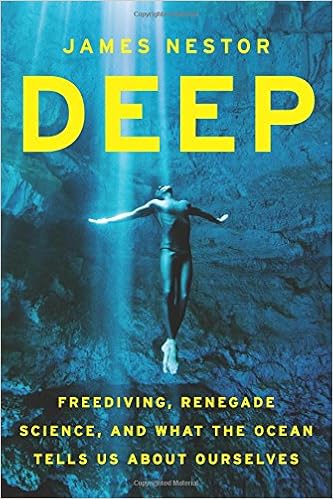
For my first IRB, I plan on reading Deep: Freediving, Renegade Science, and What the Ocean Tells Us about Ourselves by James Nestor.  This book is about one reporter's exploration of freediving- both the physical aspects of the sport, and the mental and physcological conclusions he can draw from his experiences.  I heard an interview with the author a while ago about this book, and I had been hoping to actually read the book for some time now.  I read a New York Times book review of it and the review was glowing.  I am fairly confident I will enjoy this book because I love learning about crazy sports like freediving, and the author seems like a person I can certainly relate to.

Thursday, August 27, 2015

Women and Honor: Some Notes on Lying by Adrienne Rich

Rich explores how the occasional white lie is acceptable, but the incessant use of lies in our culture leads to a lying epidemic.  Photo Credit 

In Women and Honor: Some Notes on Lying, Adrienne Rich writes about the contrasting ideas of lying and truth, especially in regards to women living in a male-dominated world.  Rich discusses how women traditionally have been taught by their culture to lie: for example, makeup, which is ever so present in our American society.  Rich explores how, historically, men are taught to be honest and honorable whereas women are rewarded for lying.  Rich was one of the most influential poets, essayists, and feminists in the second half of the 20th century.  In this essay, Rich argues that people lie for selfish reasons.  She claims, “She may say, I didn’t want to cause pain.  What she really did not want is to have to deal with the other’s pain” (Rich 8).  Rich argues this point in order for the reader to reconsider the lies that he or she tells.  Rich wants to bring awareness to the prevalence of lying in our culture, and specifically how women are often forced to lie about their affections towards other women by the institution of heterosexuality.  Rich achieves her purpose through a variety of rhetorical methods.  One method that was established throughout the essay was parallelism.  Rich repeats her sentence structure for emphasis.  She writes,

            The liar leads an existence of unutterable loneliness.

            The liar is afraid (Rich 6).

Rich repeats the grammatical structure of these sentences in order to add emphasis and organize the essay in a way that attracts the reader’s attention.  If she would have wrote instead “The liar leads an existence of unutterable loneliness and is afraid”, the effect would not be nearly as profound on the reader.  The use of the rhetorical device parallelism, coupled with metaphors sprinkled throughout the text (“There is no ‘the truth,’ ‘a truth’ – truth is not one thing, or even a system.  It is an increasing complexity.  The pattern of the carpet is a surface.  When we look closely, or when we become weavers, we learn of the tiny multiple threads unseen in the overall pattern…” (Rich 3).) allow Rich to argue her point effectively.


Total Eclipse by Annie Dillard

Dillard writes of the total eclipse of 1980.  This is a picture taken of that very eclipse Photo Credit

Total Eclipse, by Annie Dillard, is an essay in which Dillard discusses the importance of communication between people by sharing her personal experiences of a total eclipse she once saw.  Dillard’s essay is broken into 4 sections: arriving for the eclipse, the actual eclipse, the implications of the eclipse on Dillard, and going back to reality.  Dillard is writer in both fiction and nonfiction, and has won a Pulitzer Prize in 1975.  This essay first appeared in the literary journal Anteaus in 1982.  In Total Eclipse, Dillard argues that without a way to communicate experiences with other, those experiences are deemed worthless or valueless.  Dillard writes, “All those things for which we have no words are lost.  The mind – the culture – has two little tools, grammar and lexicon: a decorated sand bucket and a matching shovel” (Dillard 10). She claims that without the ability to communicate or pass down an idea, that idea will simply be lost and have no value in the world.  Dillard makes her argument by using rhetorical devices, including anecdotes and the description mode of writing (which go hand in hand).  Dillard establishes great ethos by explaining her experience with a total eclipse and how that experience is a metaphor for all experiences in life.  Dillard describes her own experience with incredible detail.  For example, she writes, “The hotel lobby was a dark, derelict room, narrow as a corridor, and seemingly without air.  We waited on a couch while the manager vanished upstairs to do something unknown to our room.  Beside us on an overstuffed chair, absolutely motionless, was a platinum-blond woman in her forties wearing a black silk dress and a strand of pearls.  Her long legs were crossed; she supported her head on her fist” (Dillard 2).  Dillard very comprehensively describes this setting, and in doing so creates a connection with the audience.  Her descriptions throughout the essay are very emotionally grasping, and pull the reader in to her world.  Because of this incredible description, I believe Dillard accomplished her purpose in writing this essay.


Wednesday, August 26, 2015

The Way to Rainy Mountain by N. Scott Momaday


Rainy Mountain in Kiowa County Oklahoma.  Momaday makes his pilgrimage to this place in order to better connect with his cultural roots.  Photo Credits
In The Way to Rainy Mountain, N. Scott Momaday discusses his cultural background by talking about his grandmother, Aho, who was part of the Native American tribe called the Kiowas.  Momaday explores the story of the Kiowas, as well as how the Kiowa culture has been present in his life and his grandmother’s life.  Navarre Scott Momaday is an established author, with much of his work garnering inspiration from his Native American roots.  Momaday received the Pulitzer Prize in 1969 for House Made of Dawn.  This essay was originally published in 197 in The Reporter, and then later used as Momaday’s introduction for the novel The Way to Rainy Mountain.  This essay is a recollection of his grandmother’s life and Kiowas culture, but also it is a personal reflection on a personal journey that Momaday experienced.  Momaday employs the rhetorical modes of description and narration in order to prove his point.  He describes the setting of the essay in great detail.  For instance he writes, “In July the inland slope of the Rockies is luxuriant with flax and buckwheat, stonecrop and larkspur.  The earth unfolds and the limit of the land recedes.  Clusters of trees, and animals grazing far in the distance, cause the vision to reach away and wonder to build upon the mind.  The sun follows a longer course in the day, and the sky is immense beyond all comparison” (Momaday 3).  Momaday’s use of descriptive language truly engage the reader.  Momaday does a fantastic job of showing rather than telling, and this descriptive nature of the essay causes the reader to feel attached.  Momaday also narrates the life of his grandmother, including information from when she was a child to the last time he saw her before death.  These two modes coupled together form an engaging essay in which Momaday can effectively translate his purpose to the reader.