Friday, September 25, 2015

TOW #3 - Protector Pope

Steve Sack - The Minneapolis Star Tribune - Protector Pope COLOR - English - Pope,Francis,immigrants,refugees
This is a political cartoon, drawn by Steve Sack, which was published in the Minneapolis Star Tribune.  Steve Sack is a liberal leaning political cartoonist who won a Pulitzer Prize in 2013 for his cartoons.  This cartoon depicts the Pope sheltering a family labeled immigrants from the storm around them.  This is a reference to the Pope’s policy and thoughts on immigration.  He is one of the most liberal Popes, if not the most, of all time, and his views on immigration reflect this.  The Pope is much more sympathetic to immigrants than many previous Popes and members of the Catholic Church.  His lenient views on immigration policy have been well documented and occasionally disputed by many, often times republicans.  The context of this cartoon is essential in order to understand it.  The Pope just gave a speech to a joint meeting of Congress and mentioned immigration.  He said, “We must not be taken aback by their numbers, but rather view them as persons, seeing their faces and listening to their stories, trying to respond as best we can to their situation, to respond in a way which is always humane, just and fraternal. We need to avoid a common temptation nowadays: to discard whatever proves troublesome.”  This makes the idea behind the cartoon justified and relevant.  Since, Sack is a liberal leaning cartoonist, it can be assumed that the he agrees with the Pope’s stance on immigration.  This is made ever clearer by the rhetorical strategy of juxtaposition between the bright whiteness of the Pope and the dark, black color of the storm surrounding him.  Sack purposefully uses the two opposite colors in order to show the contrast between the Pope’s views and the views of the Catholic Church more generally.  He makes the Pope’s aesthetic white, since white is generally considered a symbol of goodness and hope.  White is also historically symbolic of Heaven, which makes sense since the Pope is the leader of the Catholic Church.  Because of his use of contrasting colors, I believe Sack achieves his purpose.  Not only does Sack shed light on the policies of the Pope, but he also makes the argument that the Pope is correct in his views and his call for immigration leniency is right.

Saturday, September 19, 2015

Tow #2 - To Infinity and Beyond

            This week I read “To Infinity and Beyond!” by Christen Press.  Christen Press is a star soccer player for the Chicago Red Stars and the US Women’s national team- not your typical author.  For what credibility she lacks from a professional stand point, she more than makes up for in life experience.  She has overcome many obstacles in order to be where she is today; she had to play soccer in Sweden for a few years, learn a new language and culture, because the US women’s soccer league folded.  Her path to greatness, her journey, is reflected in her writing.  This specific article was found on her blog (footballschristenpress.blogspot.com) and is about the idea of being elite.  I read this article a few months ago and it has stayed with me since then.  I reread the essay, and I remember why it is so powerful: the rhetoric used by Press.  Press writes a compelling essay about how she attempts to pursue greatness.  She uses many rhetorical devices to argue her essay.  Press writes:
I have a weakness. I never feel like I’m good enough. 

I’ve set tangible goals throughout my career. And I have attained a lot of them. Still, I’m sure that achieving will never satisfy my hunger to achieve. 
Last month, Clint Bruce -- former NFL quarterback and Navy Seal Commander -- spoke to the USWNT about what he calls “pursuing elite.” Among the tokens of wisdom and experience he offered, one thing really hit home for me. “Elite is this land that is fit only for the restless,” he told us.

While I don’t know if I exist in the land of the elite, I’m definitely on the battlefield with restlessness. My restlessness leaves my mind racing as I try to wind down at the end of mandatory recovery day. It keeps me tossing after poor performances. And if I played well, well…playing well makes me itch to play better; there is always room for improvement. This process can be exhausting.

I have a strength. I never feel like I’m good enough.”

She uses similar sentences structure at the beginning and end of this passage.  This use of parallelism is incredibly impactful on the reader.  The reader has one impression early before reading the middle two paragraphs and a completely different impression afterwards.  She juxtaposes the two different aspects of never feeling as though she is good enough and provides the pros and cons to each.  This comparison is powerful because it in some ways inspires the reader; Press takes the reader on an emotional roller coaster, starting with a weakness and ending with a strength.  This organization causes the entire paragraph to end on a high note and become inspirational.  If Press had talked about the strength before the weakness, the reader would have been left with a sour taste in his or her mouth and not the inspiration that was intended.  Press appeals to pathos of the reader with inspirational paragraphs like these.  Because of the emotional connection she establishes with her audience, I believe Press is successful in her writing.

Tuesday, September 15, 2015

TOW #1 - A Blurry Line Between Bar and Restaurant

For this first TOW, I decided I wanted to read something the truly interests me.  For me, the two most interesting things in life are sports and food.  So I began the hunt to find a great article about either sports or food.  I ended up deciding on an article called A Blurry Line Between Bar and Restaurant by Pete Wells, which was written for the New York Times.  Wells has been the restaurant critic for the New York Times since 2011, and has received five James Beard Foundation Journalism Awards for his work.  This article was about the recent trend in the food industry of bars serving high quality restaurant food yet retaining the bar atmosphere.  Wells wrote this piece as part informative reporting and part argument.  His first and foremost goal was to inform the general public (specifically those in middle to high income households who can afford going out to eat on a regular basis) about this interesting trend.  He also argues for the validity of this bar-restaurant hybrid.  Wells believes that this new trend combines the great food of a restaurant with the great atmosphere of a bar.  He plugs for this type of bar, mentioning many specific bars and describing their food in great detail.  This detailed description is one of the many rhetoric devices that Wells uses.  For instance, he writes, “There may be tiny, tender and nearly gamy chops; or pork loin wrapped in a purplish and very flavorful pancetta made on site; or an odd-looking but tender cut of dry-aged steak.  A cook tosses the meat on a plancha as the air fills with the aroma of sizzling fat” (Wells 2).  This description helps his purpose because he makes this bar food sound so utterly delectable that the reader finds him/herself dying to attend one of these bars.  After reading this article, I learned much about these kinds of bars, and also wanted to try one.  Wells rhetoric and success in describing the bar food allowed his article to accomplish the purpose he desired.

Wednesday, September 9, 2015

IRB Intro Post #1

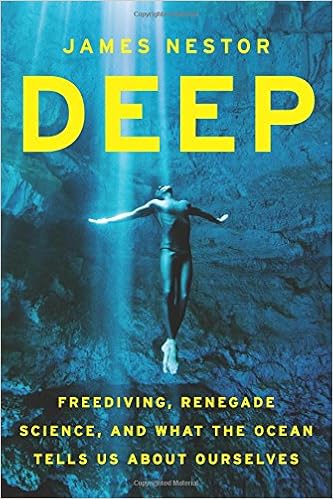
For my first IRB, I plan on reading Deep: Freediving, Renegade Science, and What the Ocean Tells Us about Ourselves by James Nestor.  This book is about one reporter's exploration of freediving- both the physical aspects of the sport, and the mental and physcological conclusions he can draw from his experiences.  I heard an interview with the author a while ago about this book, and I had been hoping to actually read the book for some time now.  I read a New York Times book review of it and the review was glowing.  I am fairly confident I will enjoy this book because I love learning about crazy sports like freediving, and the author seems like a person I can certainly relate to.